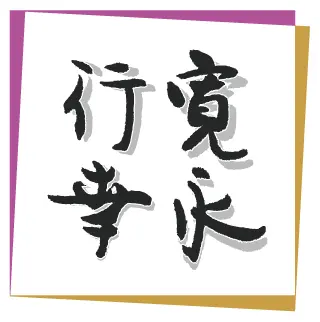

Painting by Sueo Fukuda
The Miyako Odori, a celebrated dance performance that heralds the arrival of spring in Kyoto, will this year take the Kan’ei Gyoko (Imperial Visit to Nijo Castle in 1626) as its theme. Under the title “Kan’ei Gyoko: Miyako no Hanayagi (The Splendor of the Capital)”, audiences are invited to enjoy a stage filled with the elegance and brilliance of the historic occasion amid the full beauty of spring in Gion.
The Miyako Odori is performed by 79 geiko and maiko of Gion Kobu, Kyoto’s largest hanamachi (traditional geiko and maiko entertainment district). Appearing in rotation, they present a refined and graceful world of dance over the course of a month-long performance season. Since its founding in 1872 (Meiji 5), the production has been staged every April for more than 150 years, with interruptions only during wartime, the postwar period, and the COVID-19 pandemic.
At a press conference held in February at the Gion Kobu Kaburenjo Theatre, it was announced that the title of this year’s 152nd performance would be “Kan’ei Gyoko Miyako no Hanayagi.”
The curtain of the Miyako Odori rises to the lively call of “Yo-i-yasa!” One of the most spectacular moments is the opening “Sō-odori” (grand ensemble dance), in which geiko and maiko appear together in matching light indigo costumes. The costumes, newly created each year, are also among the highlights of the production. This year’s designs were introduced as well: the kimono motif “Kan’ei no Kyōō (The Reception for the Kan’ei Gyoko)” and the obi pattern “Aoi no Maru Kasumi-mon (Circular Hollyhock and Mist Pattern).”


A cascading weeping cherry blossom motif extending from the shoulders of the kimono is a traditional design of the Miyako Odori. In this year’s costume, decorative noshi ribbon motifs flow elegantly across the garment from the bodice to the hem, centered around the Imperial chrysanthemum crest, evoking festive ornaments prepared to welcome the Emperor’s procession.
The obi belt features circular hollyhock crests, symbolizing the three-leaf hollyhock emblem of the Tokugawa shogunal family, arranged in vibrant colors over a kasumi (mist) pattern, an auspicious motif representing eternity and continuity.

The Miyako Odori consists of eight scenes, presented over approximately one hour. Characteristically, the stage transforms seamlessly without the curtain ever closing, expressing the changing seasons and themes from classical literature.
Since 2014, the script and composition of the performance have been overseen by Asako Ueki, who explains:
“This year’s production commemorates the 400th anniversary of the Kan’ei Gyoko while also reflecting on Kan’ei Culture, which flourished around the cultural salon of Emperor Go-Mizunoo.”

Kyoko Sugiura, Chair of the Board, Yasaka Nyokoba Gakuen Educational Corporation (organizer);
Yachiyo Inoue V, Head of the Inoue School of Kyomai (choreography and stage direction);
Asako Ueki, Professor at the Faculty of Letters, Doshisha University (lyrics and composition).
In particular, the third scene, “Illustrated Scroll of the Imperial Reception for Emperor Go-Mizunoo,” depicts a banquet held at Nijo Castle, where Tokugawa Hidetada and Tokugawa Iemitsu welcomed the Emperor. With the palace buildings and front garden of Nijo Castle as the backdrop, the performance expresses through dance scenes inspired by bugaku (court dance accompanied by gagaku music) and a kemari (court football game).
Ueki notes:
“Although the historical record Kan’ei Gyoko-ki does not list bugaku performances in the original program, we included the ‘Dance of the Butterflies’ (Kochō-no-mai) to convey the characteristic elegance and charm of the Miyako Odori. We hope audiences will enjoy this radiant stage while recalling the splendor of the historic Imperial visit.”
Blending traditional artistry with contemporary stage direction, the production culminates in the eighth scene, “Cherry Blossom Snowstorm at Nijo Castle.” With the castle’s cherry blossoms in full bloom as the backdrop, 36 geiko and maiko perform together in a grand finale.

Courtesy of the Gion Kobu Kabukai.
Performance Information
Dates: April 1 (Wed) – April 30 (Thu), 2026
The first performance on April 23 and 24 will be reserved for private bookings.
Daily Performances: Three performances per day (approx. 60 minutes each)
- 12:30
- 14:30
- 16:30
Venue:
Gion Kobu Kaburenjo Theatre
(570-2 Gionmachi Minamigawa, Higashiyama Ward, Kyoto)
Tickets:
- First-class seat with tea service: 7,000 yen
- First-class seat: 6,000 yen
- Second-class seat: 4,000 yen
- Student second-class seat: 2,000 yen
(Elementary students accompanied by a guardian, or students of junior high school, high school, university, or vocational institutions)
All seats are reserved. Tickets are also available online:https://miyako-odori.jp/miyako/
Inquiries:
Gion Kobu Kabukai
Tel: +81-75-541-3391
Organized by:
Yasaka Nyokoba Gakuen Educational Corporation / Gion Kobu Kabukai
Cooperation:
Kyoto City Tourism Association