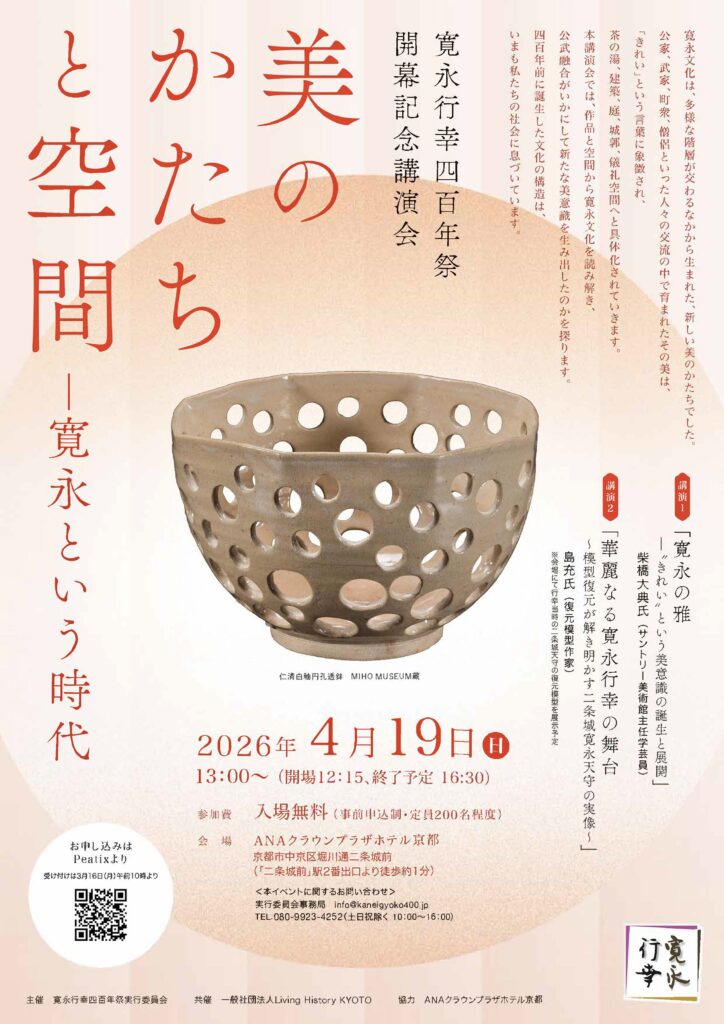
Kan’ei culture gave rise to new forms of beauty that emerged through the interaction of diverse social groups.
Within exchanges among kuge (court nobility), buke (the samurai or warrior class), machishu (townspeople), and Buddhist monks, a shared aesthetic gradually took shape. This sensibility came to be symbolized by the word kirei—meaning refined elegance or beauty—and was expressed in practices and spaces such as chanoyu (the tea ceremony), architecture, gardens, castles, and ceremonial settings.
This lecture will explore Kan’ei culture through works of art and spatial design, examining how the harmonization of the Imperial Court and the Tokugawa Shogunate gave rise to a new aesthetic consciousness.
The cultural framework that emerged four hundred years ago continues to resonate within our society today.
Event Information
Date: Sunday, April 19, 2026
12:15 — Doors open
13:00 — Opening remarks
13:10 — Lecture 1
“Elegance of the Kan’ei Era — The Birth and Development of the Aesthetic of ‘Kirei’”
Speaker: Daisuke Shibahashi (Chief Curator, Suntory Museum of Art)
14:40 — Tea break
15:00 — Lecture 2
“The Magnificent Stage of the Kan’ei Gyoko — Reconstructing the Tenshu of Nijo Castle through Scale Models”
Speaker: Mitsuru Shima (Architectural model reconstruction artist)
※ A reconstruction model of the tenshu (castle keep) of Nijo Castle as it appeared at the time of the Gyoko will be exhibited at the venue.
16:30 — Scheduled conclusion
Venue
ANA Crowne Plaza Hotel Kyoto
Horikawa-dori, Nijojo-mae, Nakagyo Ward, Kyoto
Approx. 1 minute on foot from Exit 2 of “Nijojo-mae” Station
Participation
Admission free (advance registration required; capacity approx. 200 participants)
Registration via Peatix:https://kaneibunka20260419.peatix.com
Applications open from 10:00 AM on Monday, March 16.
Lecture Details
▶“Elegance of the Kan’ei Era — The Birth and Development of the Aesthetic of ‘Kirei’”
This lecture will clarify the points of intersection among courtly culture, samurai culture, and popular culture that together formed Kan’ei culture. Through concrete examples of artworks, it will examine how the aesthetic concept expressed by the word kirei emerged and became widely shared.
Speaker Profile — Daisuke Shibahashi
Born in Osaka Prefecture in 1983.
Specialized in Japanese art history at the Graduate School of Tohoku University. His research focuses on early modern painting and craft history, including the Kano school, Tosa school, uta-e (poetic painting), and works by Ogata Kenzan.
In 2018, he curated the exhibition “Elegance of the Kan’ei Era — Court Culture of Edo and Enshu, Ninsei, and Tan’yu” at the Suntory Museum of Art.
▶“The Magnificent Stage of the Kan’ei Gyoko — Reconstructing the Tenshu of Nijo Castle through Scale Models”
Using a reconstruction model, this lecture will examine the castles and ceremonial spaces of the Kan’ei period in three-dimensional form. It will consider the significance of the Emperor ascending the tenshu, a structure that symbolized the authority of the warrior class, as well as the spatial composition of the castle, including the role of architectural “emptiness” or negative space.
Speaker Profile — Mitsuru Shima
Born in Fukuoka Prefecture in 1982.
Architectural model artist specializing in castles and historical buildings; graduate of Keio University. He is widely known for highly realistic reconstructions based on meticulous research of historical photographs and illustrated documents. His works include numerous models such as Kumamoto Castle and Hiroshima Castle. In 2023 he received the Japan Castle Culture Special Award.
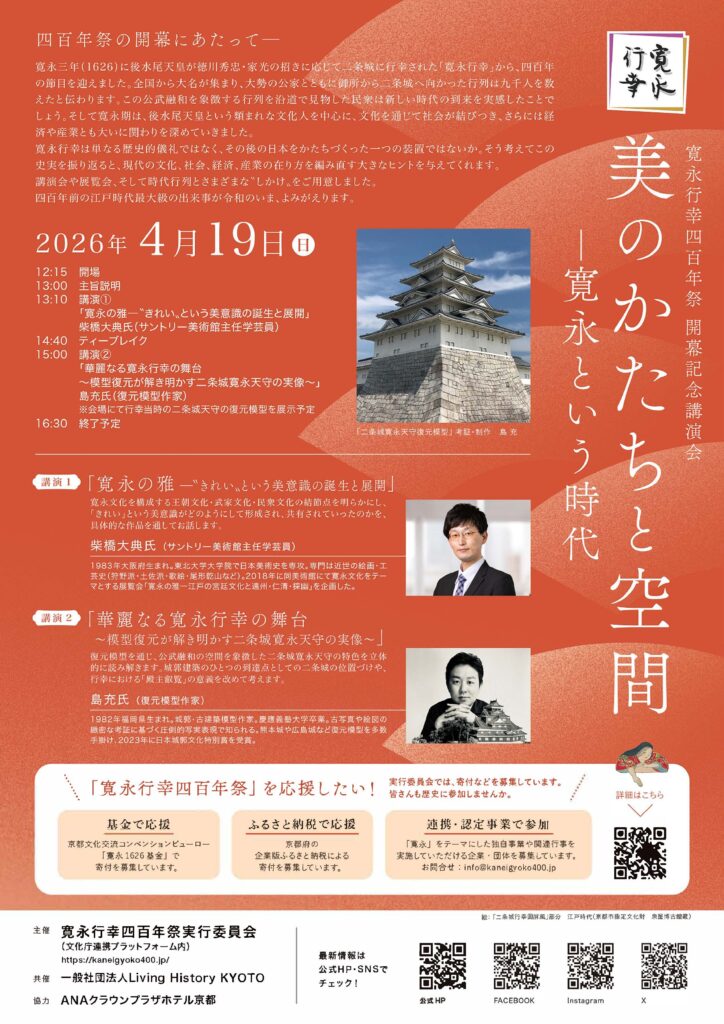
Message — On the Opening of the 400th Anniversary
The year 2026 marks the four-hundredth anniversary of the Kan’ei Gyoko, when Emperor Go-Mizunoo visited Nijo Castle in 1626 at the invitation of Tokugawa Hidetada and Tokugawa Iemitsu.
It is said that the procession departing from the Gosho (Kyoto Imperial Palace) and proceeding to Nijo Castle numbered around 9,000 participants, including daimyo from across the country as well as many court nobles. For the common people who watched the procession along the route, this magnificent spectacle symbolizing the reconciliation of the Imperial Court and the Tokugawa Shogunate must have made them feel that a new era had begun.
During the Kan’ei era, with Emperor Go-Mizunoo—an extraordinary patron of culture—at its center, society became increasingly connected through cultural activities, while also deepening its relationship with economic and industrial life.
Seen from this perspective, the Kan’ei Gyoko was not merely a historical ceremony. It may be understood as a mechanism that helped shape the course of Japanese society thereafter. Reflecting on this historical event offers important hints for reconsidering the forms of culture, society, economy, and industry today.
To mark this anniversary, we have prepared a range of programs—including lectures, exhibitions, and a historical procession. One of the greatest events of the Edo period will be brought back to life in the present Reiwa era.
Inquiries
Executive Committee Secretariat
info@kaneigyoko400.jp
Organizer: Executive Committee for the 400th Anniversary of the Kan’ei Gyoko
Co-organizer: Living History KYOTO
Cooperation: ANA Crowne Plaza Hotel Kyoto