In 1626 (Kan’ei 3), Emperor Go-Mizunoo visited Nijo Castle at the invitation of Tokugawa Hidetada, the second shogun of the Tokugawa Shogunate, and Tokugawa Iemitsu, the third shogun.
This Kan’ei Gyoko (Imperial Visit to Nijo Castle in 1626) was an exceptionally symbolic event in Japanese history, bringing together the distinct cultural traditions of the Imperial Court and the warrior class and providing an opportunity for them to share their artistic and aesthetic values.
The procession included powerful daimyo from across Japan, among them Date Masamune. Over the course of five days, Nijo Castle became the stage for an extraordinary program of courtly hospitality featuring Noh, bugaku (court dance accompanied by gagaku music), waka poetry, and many other cultural performances.
This lecture explores the historical significance of the Kan’ei Gyoko and examines the important role that Noh played during this remarkable era. It also introduces episodes connected with Date Masamune, a noted patron of Noh, during the flourishing of Kan’ei culture. The program concludes with a shimai (an excerpt from a Noh dance performed in formal costume but without full staging) inspired by works associated with this period.
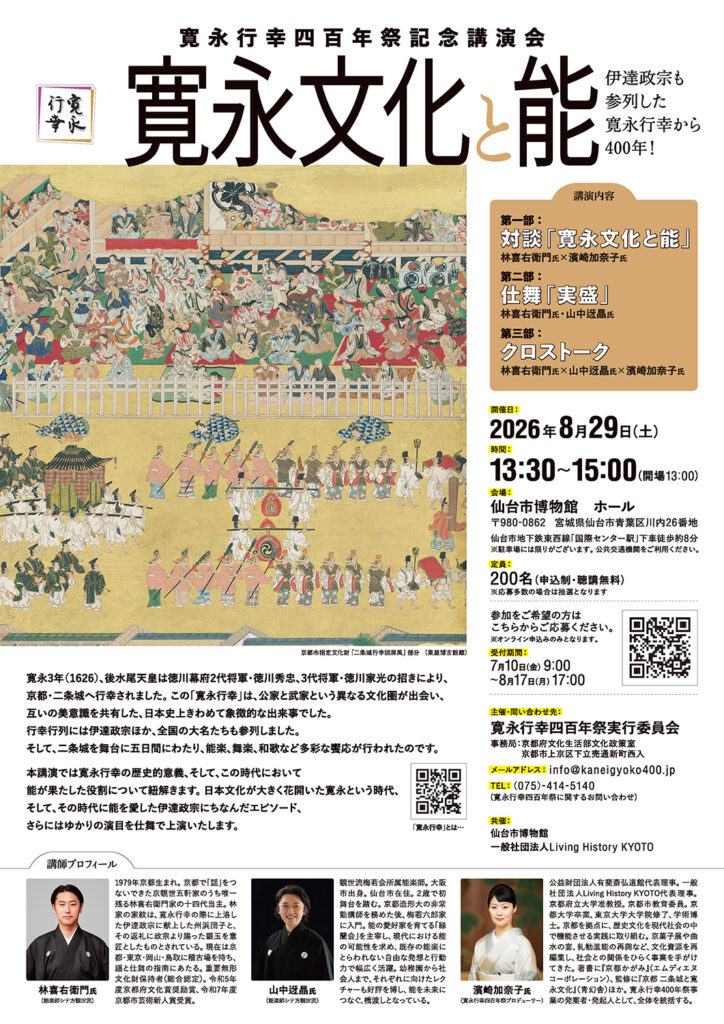
Date & Time
Saturday, August 29, 2026
1:30 p.m. – 3:00 p.m. (Doors open at 1:00 p.m.)
Venue
Sendai City Museum
26 Kawauchi, Aoba-ku, Sendai, Miyagi 980-0862, Japan
Approximately 8 minutes on foot from International Center Station on the Sendai Subway Tozai Line.
Parking is limited. Visitors are encouraged to use public transportation.
※Special Exhibition Now Open: “Date Masamune’s Challenge—Can You Solve My Quiz?”
Capacity
200 participants (Advance registration required / Free admission)
If the number of applications exceeds capacity, participants will be selected by lottery.
Program
Part I Dialogue: “Kan’ei Culture and Noh”
Kiuemon Hayashi × Kanako Hamasaki
Part II Shimai Performance: Sanemori
Kiuemon Hayashi & Gasho Yamanaka
Part III Cross Talk
Kiuemon Hayashi × Gasho Yamanaka × Kanako Hamasaki
Speaker Profiles
Kiuemon Hayashi
Noh Performer (Shite Actor), Kanze School
Born in Kyoto in 1979, Kiuemon Hayashi is the fourteenth head of the Hayashi family, the only surviving household among the five distinguished Kyoto Kanze families that have preserved the tradition of utai (Noh chanting) in Kyoto.The Hayashi family crest is said to combine the design of suhama dango (shoreline-shaped rice dumplings) presented to Date Masamune during the Kan’ei Gyoko, together with a silver ornament bestowed by Masamune in return.He currently teaches utai and shimai in Kyoto, Tokyo, Okayama, and Tottori. He is a Holder of Important Intangible Cultural Property (Collective Recognition) and has received the Kyoto Prefectural Cultural Award (Encouragement Prize, FY2023) and the Kyoto City New Artist Award (FY2025).
Gasho Yamanaka
Noh Performer (Shite Actor), Kanze School
A member of the Umewaka Association of the Kanze School, Chikusho Yamanaka was born in Osaka and is now based in Sendai. He made his stage debut at the age of two.After serving as a part-time lecturer at Kyoto University of Art and Design, he studied under Rokuro Umewaka. Through his organization Ryokurankai, he cultivates new audiences for Noh while exploring its possibilities in the contemporary world with an open and innovative approach that extends beyond conventional practice.His lectures, presented to audiences ranging from kindergarten children to working professionals, have been widely acclaimed, helping to connect the tradition of Noh with future generations.
Kanako Hamasaki
Representative Director of the Yuhisai Kodokan Foundation, Representative Director of Living History KYOTO, Associate Professor at Kyoto Prefectural University, and Member of the Kyoto City Board of Education. He graduated from Kyoto University and completed his graduate studies at the University of Tokyo, where he earned a Ph.D.
Based in Kyoto, he is engaged in projects that bring the city’s historical and cultural heritage into meaningful dialogue with contemporary society. His work includes the Kyogashi Exhibition, the revival of the Kyokusui-no-En (Poetry Festival by a Winding Stream), and the restoration of the Tadasu Kanjin Noh performance tradition, all of which reinterpret cultural resources and create new connections between heritage and the public.
His publications include Kyoto Kagami (MdN Corporation), and he served as supervising editor for Kyoto’s Nijo Castle and Kan’ei Culture (Seigensha), among other works.
As the originator and founding organizer of the Kan’ei Gyoko 400th Anniversary Festival, he oversees the project as its overall director.
Registration
Advance registration is available online.
Register to Attend
Organizer & Contact
Kan’ei Gyoko 400th Anniversary Festival Executive Committee
Secretariat: Cultural Policy Office, Department of Culture and Lifestyle, Kyoto Prefectural Government
Shimodachiuri-dori, Shinmachi Nishi-iru, Kamigyo-ku, Kyoto