With the Summer Siege of Osaka in 1615, the age of warfare came to an end, and the Tokugawa Shogunate established a secure political foundation. The shogunate then moved swiftly to build its relationship with the Imperial Court. Just eleven years later came the Kan’ei Gyoko. While it was celebrated as a magnificent event that brought vibrant festivities to the streets of Kyoto, it also embodied a complex web of political intentions.
What is Nijo Castle? It has been described as “the castle that created the shogun,” “the center of the Tokugawa Shogunate’s policy toward the Imperial Court,” and “a symbol of Tokugawa authority.” Yet no single description fully captures its significance. This lecture examines the many roles of Nijo Castle, the political objectives behind the shogunate’s invitation to Emperor Go-Mizunoo, and the Emperor’s own strategy in accepting it. Through this lens, it explores the political dimensions of the Kan’ei Gyoko as a landmark event that embodied the close relationship between the Imperial Court and the Tokugawa Shogunate.
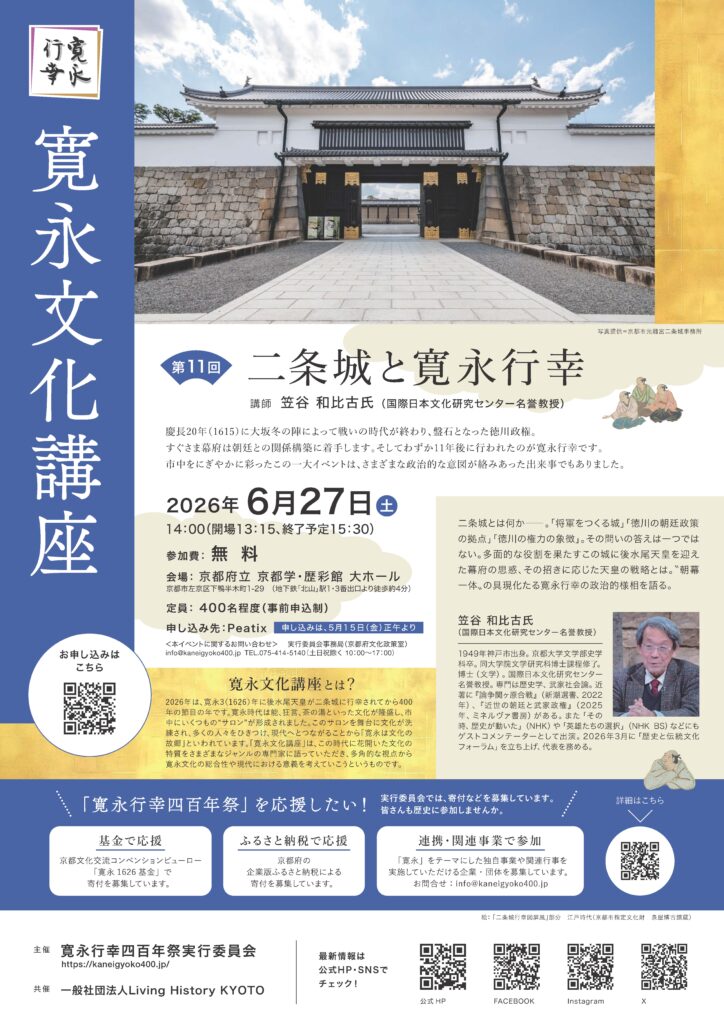
Date & Time: Saturday, June 27, 2:00 p.m. (Doors open at 1:15 p.m.; scheduled to conclude at 3:30 p.m.)
Venue
Main Hall, Kyoto Institute, Library and Archives (Rekisaikan)
1-29 Shimogamo Hangicho, Sakyo Ward, Kyoto
Approximately a 4-minute walk from Exits 1 or 3 of Kitayama Station on the Kyoto Municipal Subway Karasuma Line.
Admission: Free (Advance registration required; capacity approximately 400 people)
Please register via Peatix.
https://kaneibunka20260627.peatix.com
Profile
Kazuhiko Kasaya (Professor Emeritus, International Research Center for Japanese Studies)
Born in Kobe in 1949, Kazuhiko Kasaya graduated from the Department of History, Faculty of Letters, Kyoto University, and completed the doctoral program at the university’s Graduate School of Letters. He holds a Ph.D. in Literature and is Professor Emeritus at the International Research Center for Japanese Studies. His fields of specialization are Japanese history and the study of warrior society.
His recent publications include Sekigahara: Debating the Decisive Battle (Shincho Sensho, 2022) and The Imperial Court and the Warrior Government in Early Modern Japan (Minerva Shobo, 2025). He has also appeared as a guest commentator on NHK’s Sono Toki, Rekishi ga Ugoita (“When History Was Made”) and NHK BS’s Eiyū-tachi no Sentaku (“The Choice of Heroes”). In March 2026, he founded the History and Traditional Culture Forum, where he serves as its representative.
Organizers and Contact
Organizer: Kan’ei Gyoko 400th Anniversary Festival Executive Committee (within the Agency for Cultural Affairs Collaboration Platform)
Inquiries: info@kaneigyoko400.jp
Co-organizer: Living History KYOTO