This public lecture series, jointly organized by Yuhisai Kodokan and the Society for Early Modern Kyoto Studies, began in 2011.
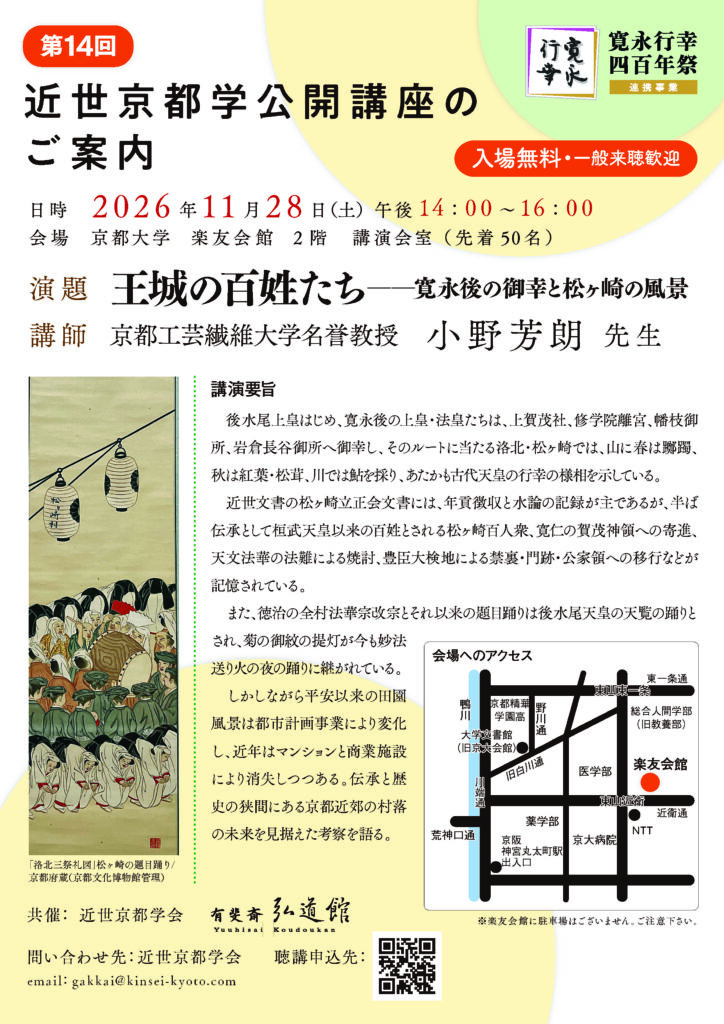
For this year’s 14th lecture, we are pleased to welcome Yoshiro Ono, Professor Emeritus at Kyoto Institute of Technology, who will speak on the Imperial Visits of retired emperors and retired emperors who had entered Buddhist priesthood, and the landscape of Matsugasaki in northern Kyoto.
Lecture Abstract
Retired emperors and retired emperors who had entered the Buddhist priesthood, including Retired Emperor Go-Mizunoo, made Imperial Visits to Kamigamo Shrine, the Shugakuin Imperial Villa, the Hataeda Imperial Residence, and the Iwakura Hase Imperial Residence.
Matsugasaki, in northern Kyoto, lay along the routes of these visits. In spring, the visitors enjoyed azaleas blooming on the mountainsides; in autumn, the changing leaves and matsutake mushrooms; and in the rivers, ayu (sweetfish). These scenes were reminiscent of the Imperial Visits undertaken by emperors in ancient times.
According to local tradition, the Matsugasaki Hyakuninshu (the Hundred Families of Matsugasaki) traced their origins to the reign of Emperor Kanmu. The village’s documented history also includes the donation of land to the Kamo Shrine estates during the Kannin era, the burning of the village during the Tenbun Hokke Persecution, and the transfer of land into the estates of the Imperial Court, monzeki temples (Buddhist temples headed by members of the Imperial family or aristocracy), and court aristocrats following Toyotomi Hideyoshi’s nationwide land survey.
In the early modern period, the Matsugasaki Risshokai Documents recorded the history of the village, particularly matters relating to the collection of annual land taxes and disputes over water rights.
The entire village is also said to have converted to the Hokke school of Buddhism during the Tokuji era. The Daimoku Odori (Buddhist devotional dance), which has been performed since that time, is traditionally believed to have been viewed by Emperor Go-Mizunoo. Lanterns bearing the Imperial chrysanthemum crest remain part of the dance performed today on the night of the Myoho ceremonial bonfires.
Meanwhile, the rural landscape that had characterized Matsugasaki since the Heian period has been transformed by urban planning projects. In recent years, further changes, including the construction of apartment buildings and commercial facilities, have continued to erode this historic landscape.
This lecture will trace these developments to explore the history and character of Matsugasaki, a village on the outskirts of Kyoto whose past lies at the intersection of tradition and documented history, while also considering its future.
Event Information
| Lecturer | Yoshiro Ono, Professor Emeritus, Kyoto Institute of Technology |
|---|---|
| Venue | Rakuyu Kaikan, Kyoto University, Yoshida Nihonmatsu-cho, Sakyo-ku, Kyoto 606-8315. ▶View on Google Maps ※Please note that parking is not available at Rakuyu Kaikan. |
| Admission | Free. Open to the general public. |
| Registration | Please register using the link below. Capacity is limited to 50 participants, on a first-come, first-served basis. https://peatix.com/event/5174886 |
| Co-organizers | Society for Early Modern Kyoto Studies / Yuhisai Kodokan |
| Inquiries | Society for Early Modern Kyoto Studies. email:gakkai@kinsei-kyoto.com |