On May 17, 2026, the Kan’ei Culture Lecture, “The Kan’ei Gyoko Through the Lens of the Performing Arts: The Emperor and Noh, the Warrior Class and Gagaku,” was held by the Kan’ei Gyoko 400th Anniversary Festival Executive Committee, co-organized by Living History KYOTO, with the cooperation of the Shimogamo Shrine Tadasu Noh Preservation Society. The event took place in the Main Hall of the Kyoto Institute, Library and Archives (Rekisaikan).
The program consisted of two sessions. In the first session, “The Emperor and Noh,” Shinpei Matsuoka (Professor Emeritus, The University of Tokyo) delivered a lecture. In the second session, “The Warrior Class and Gagaku,” Junpei Yamada (Senior Specialist, Nara Prefecture Cultural Properties Division) gave a presentation.
Each lecture was followed by a discussion with distinguished guests: Kiuemon Hayashi (Noh actor, shite performer, and the 14th head of the Hayashi family) after the first session, and Shinryu Ono (Visiting Professor at Kansai University and President of the Tennoji Gakuso Garyokai) after the second.
In the first session, Shinpei Matsuoka explored the history of Noh in Kyoto, tracing its development from okina sarugaku (an early form of ceremonial Noh performance) in the Heian period to the early modern era, with particular attention to its relationship with the Emperor. His lecture drew on a wide range of historical sources to illuminate the Noh performances associated with the Kan’ei Gyoko, offering many fascinating insights into this remarkable event.
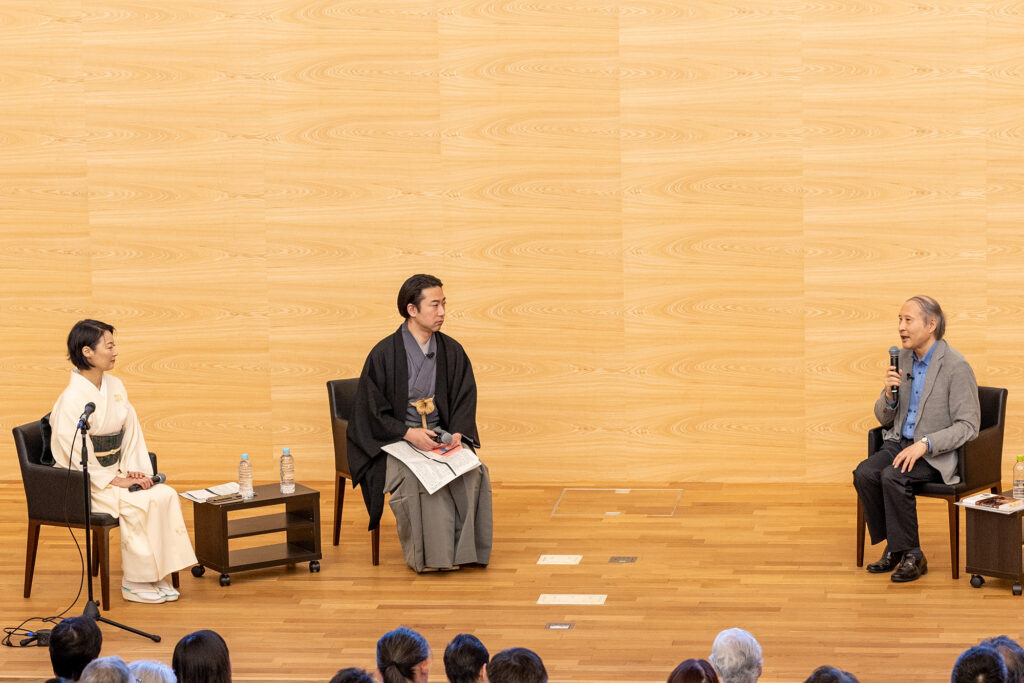
Panel Discussion
Kanako Hamasaki, Kiuemon Hayashi, and Shinpei Matsuoka
The panel discussion was moderated by Kanako Hamasaki, Producer of the Kan’ei Gyoko 400th Anniversary Festival Executive Committee. Joined by Kiuemon Hayashi, whose family marks the 400th anniversary of its role as hereditary instructors of utai (Noh chanting), the speakers explored the history of Noh and its continuing relevance today through the lens of the Kan’ei Gyoko.
In the afternoon session, Junpei Yamada presented an engaging overview of the history of gagaku (traditional Japanese court music), focusing on the Kan’ei Gyoko as a key turning point and tracing how the tradition moved between the Imperial Court and the warrior class.
Using a series of illustrated slides, he clearly explained the relationship between gagaku and the great unifiers of Japan—including Oda Nobunaga, Toyotomi Hideyoshi, and Tokugawa Ieyasu—before exploring the development of gagaku during the Kan’ei era and its role in the Kan’ei Gyoko.
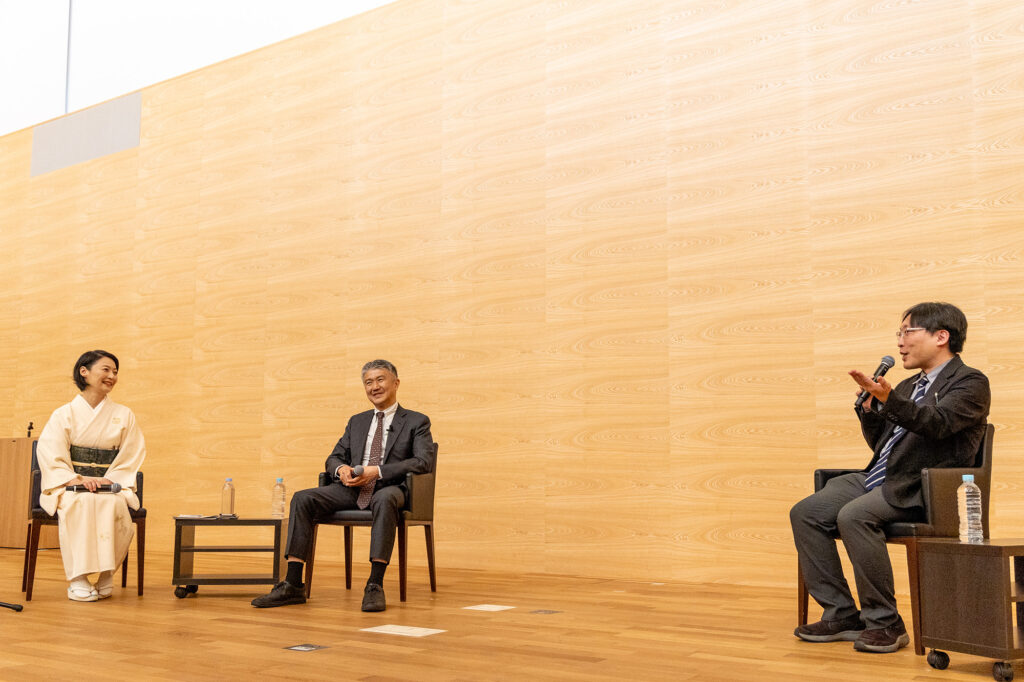
Panel Discussion
Kanako Hamasaki, Shinryu Ono, and Junpei Yamada
During the panel discussion, the speakers explored the political and cultural intentions reflected in the gagaku repertoire and ensemble performed during the Kan’ei Gyoko. They also discussed how gagaku, while rooted in the traditions of the Imperial Court, was preserved and transformed within early modern Japanese society.
The insightful discussions and personal perspectives shared by the speakers provided the audience with a deeper understanding of the performing arts associated with the Kan’ei Gyoko.
We extend our sincere thanks to all of the speakers and to everyone who attended the event.
Photo: Masaki Hashimoto