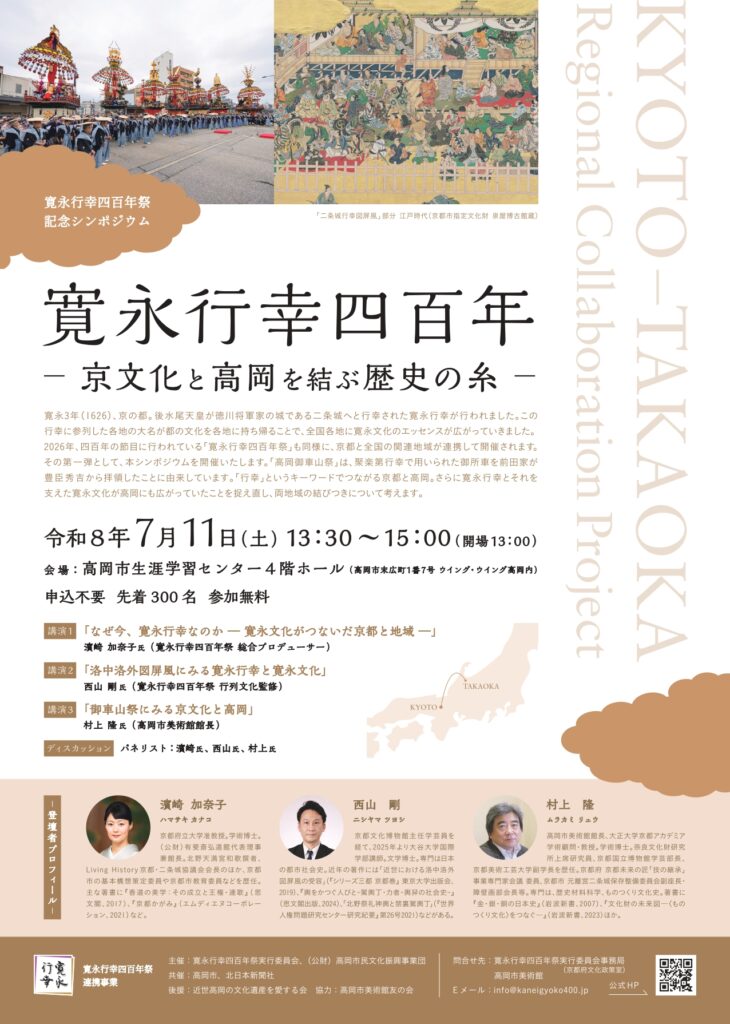
The collaborative project for the Kan’ei Gyoko 400th Anniversary Festival, “Kan’ei Gyoko (Imperial Visit to Nijo Castle in 1626) 400 Years: The Historical Connection Linking Kyoto Culture and Takaoka,” will be held on Saturday, July 11, at the Takaoka City Lifelong Learning Center in Toyama Prefecture.
The daimyo who attended the Kan’ei Gyoko brought the culture of the capital back to their respective regions, allowing the essence of Kan’ei culture to spread throughout Japan. In the same way, the Kan’ei Gyoko 400th Anniversary Festival will be held through collaboration between Kyoto and regions across Japan connected to this historical event. This event will be the first in the series.
The Takaoka Mikurumayama Festival has its origins in the fact that the Maeda family received the go-shoguruma (ox-drawn carriage used by the Imperial Court) that had been used during the Imperial Visit to Jurakudai from Toyotomi Hideyoshi. Kyoto and Takaoka are connected through the keyword “Gyoko (Imperial Visit).” This event will revisit how the Kan’ei Gyoko and the Kan’ei culture that supported it also spread to Takaoka, and will explore the historical ties between the two regions.
[Event Details]
Date and Time: Saturday, July 11, 2026, 1:30 p.m. – 3:00 p.m. (Doors open at 1:00 p.m.)
Venue: Takaoka City Lifelong Learning Center, 4th Floor Hall
(Inside Wing Wing Takaoka, 1-7 Higashihirokoji, Takaoka City)
Registration: Not required
Capacity: First 300 participants
Admission: Free
・Lecture 1
“Why Kan’ei Gyoko (Imperial Visit to Nijo Castle in 1626) Matters Today — Kyoto and Regional Communities Connected Through Kan’ei Culture —”
Ms. Kanako Hamasaki (General Producer of the Kan’ei Gyoko 400th Anniversary Festival)
・Lecture 2
“Kan’ei Gyoko and Kan’ei Culture as Depicted in the Rakuchu Rakugai-zu Folding Screens”
Mr. Tsuyoshi Nishiyama (Supervisor of Procession Culture for the Kan’ei Gyoko 400th Anniversary Festival)
・Lecture 3
“Kyoto Culture and Takaoka as Seen Through the Mikurumayama Festival”
Ryu Murakami (Director of the Takaoka Art Museum)