The “Daigoji Documents and Sacred Texts” (Daigoji Monjo Shogyo) is a collection of historical materials on paper preserved at Daigoji Temple. It comprises documents, including letters dating from the Nara period (710–794) to the modern era, as well as sacred texts explaining the rituals and doctrines of Esoteric Buddhism. Successive generations of monks and others have safeguarded these materials through periods of warfare and the haibutsu kishaku movement (the anti-Buddhist movement of the early Meiji period).
A comprehensive survey of the collection began in 1914, led by Dr. Katsumi Kuroita of Tokyo Imperial University. This work is now being continued by the Daigoji Cultural Properties Research Institute, directed by Makoto Nagamura, Professor Emeritus at Japan Women’s University. Based on the findings of these investigations, the Agency for Cultural Affairs subsequently began its own assessment for cultural property designation.
The collection was designated as an Important Cultural Property in successive stages: Boxes 1–100 in 1989, Boxes 101–300 in 2000, Boxes 301–500 in 2010, and Boxes 501–558 in 2013. At the same time, the collection was elevated to National Treasure status under the collective designation “Daigoji Documents and Sacred Texts.”
In 2026, Boxes 559–815 were additionally designated as National Treasures, completing the designation of the collection. To commemorate this milestone, selected materials from the collection will be placed on public display.
Box 132 of the “Daigoji Documents and Sacred Texts”
〈National Treasure〉 Kan’ei Hibi-ki (Daily Records of the Kan’ei Era)
Early Edo Period, Kan’ei Era
The Kan’ei Hibi-ki consists of 15 volumes documenting Daigoji Temple’s annual ceremonies and events, as well as matters concerning Kakujō, the temple’s head priest at the time. Each volume covers one year, spanning the period from 1630 (Kan’ei 7) to 1644 (Kan’ei 21 / Shōhō 1).
The entry dated September 13, 1631 (Kan’ei 8), contains the following record:
“One pair of folding screens depicting The Tale of Genji, painted by Sōtatsu. One gold coin. Completed today. A splendid work.”
The screens mentioned in this entry are believed to be the National Treasure Scenes from The Tale of Genji: Sekiya and Miotsukushi, a pair of six-panel folding screens painted in color on gold-leafed paper, now held by the Seikadō Bunko Art Museum in Tokyo.
It is thought that the screens were presented as a token of gratitude to Iwasaki Yanosuke, founder of the Seikadō collection and the second head of Mitsubishi, who made a substantial donation to Daigoji Temple around 1895 (Meiji 28).
This exhibition will display the entry from the Kan’ei Hibi-ki containing the reference to these screens.
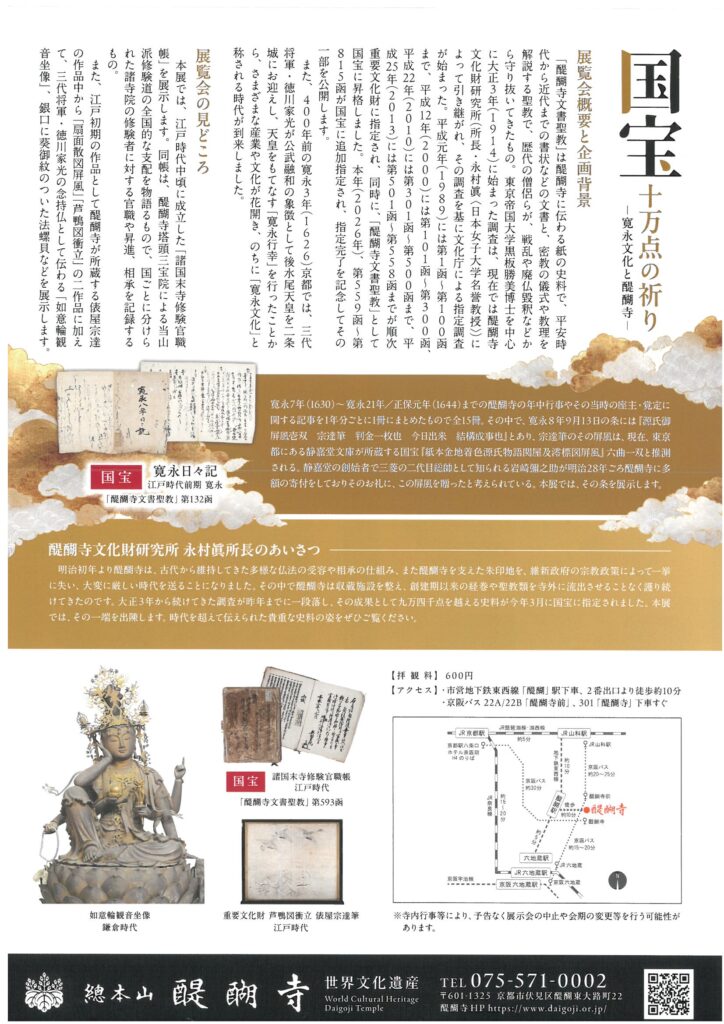
Another highlight of the exhibition is the Shokoku Matsuji Shugen Kanshokucho (Register of Official Positions of Shugendo Practitioners at Branch Temples Throughout Japan), compiled around the middle of the Edo period.
This register illustrates the nationwide authority exercised by Sanboin, a subtemple of Daigoji Temple, over the Tozan-ha branch of Shugendo (a Japanese tradition of mountain asceticism). Organized by province, it records the official positions, promotions, and succession of Shugendo practitioners affiliated with temples throughout Japan.
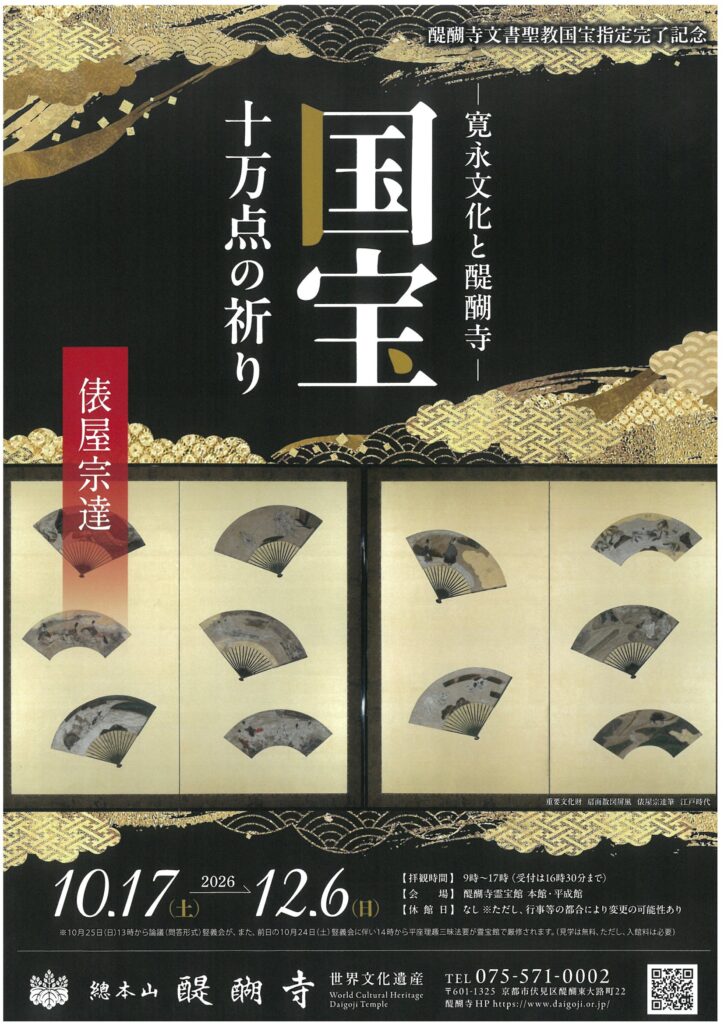
The exhibition will also feature two early Edo-period works by Tawaraya Sotatsu from Daigoji Temple’s collection: Folding Screen with Scattered Fans and Reed and Ducks on a Standing Screen.
Other exhibits include a seated statue of Nyoirin Kannon (the Wish-Fulfilling Avalokiteshvara), traditionally believed to have been the personal devotional Buddhist image of Tokugawa Iemitsu, the third Tokugawa shogun, and a conch-shell trumpet fitted with a silver mouthpiece bearing the Tokugawa hollyhock crest.
We warmly invite you to view these precious historical materials and works of art, carefully preserved and passed down through the centuries.
Exhibition Information
| Exhibition Period | Saturday, October 17 – Sunday, December 6, 2026. Please note that the exhibition may be cancelled or its dates changed without prior notice due to temple ceremonies or other events. |
|---|---|
| Opening Hours | 9:00 a.m.–5:00 p.m. (Last admission at 4:30 p.m.) |
| Venue | Daigoji Reihokan Museum, Main Building and Heisei Building 22 Daigo Higashioji-cho, Fushimi-ku, Kyoto 601-1325, Japan Access By subway: Approximately 10 minutes on foot from Exit 2 of Daigo Station on the Kyoto Municipal Subway Tozai Line. From Yamashina or Rokujizo Station: Take Keihan Bus No. 22 or 22A and get off at the “Daigoji-mae” bus stop, immediately outside the temple. From Kyoto Station: Take Keihan Bus No. 301 to the “Daigoji” bus stop. Telephone: 075-571-0002 |
| Closed | No scheduled closing days. However, this may change due to temple ceremonies or other events. |
| Admission | ¥600 |