“Kan’ei Gyoko 400th Anniversary Festival Opening Forum & Reception” (April 12, 2026)
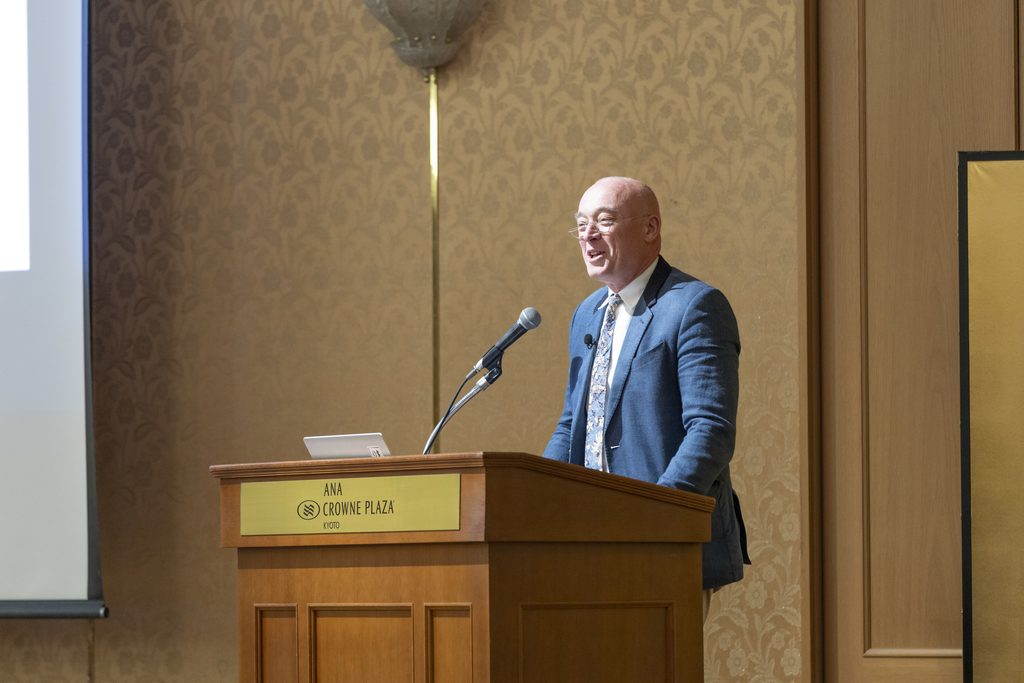
I am Timon Screech, as I have just been introduced. I was invited to speak at this gathering, and I decided to talk about how people from overseas viewed Kyoto during the Kan’ei era. In fact, however, there were few periods when so few foreigners came to Kyoto as during the Kan’ei era.
By that time, the Jesuits had long since been expelled under the edicts banning Christian missionaries and were no longer in Japan, so there are no Jesuit accounts of Kyoto from this period. The English East India Company also withdrew from Japan in 1623, just before the Kan’ei era began, and roughly ten years later, following the Shimabara Rebellion, the Portuguese were expelled as well.
The Kan’ei era was therefore a period when relatively few foreigners were present in Japan. During this time, however, a Siamese mission came to Japan around the same period as the English. This was just when the English came to Kyoto in preparation for their withdrawal. The shogun was in Kyoto at the time, so they came to make their final farewell and report that they were leaving Japan. A Siamese ambassador was also in Kyoto at almost exactly the same time. Unfortunately, I cannot read the Siamese records, so I cannot speak about them today, but I think this would make a very interesting subject for future research.
During the Kan’ei era, the Dutch had a trading post at Hirado. After they incurred the shogun’s displeasure through conduct regarded as disrespectful, however, they were moved from Hirado, which was under the rule of the Matsuura family, to Nagasaki. Nagasaki was shogunal territory, known as tenryo, so the Dutch were relocated to a place where they could be more closely supervised. From that year, 1641, they traveled between Nagasaki and Edo almost every year. This marked the beginning of what was known as sanpu, the journey to pay respects to the shogunal government. As a result, during the Kan’ei era the Dutch passed through Kyoto at least twice a year: once on their way to Edo and once on their return journey.
I would now like to turn to the Dutch. Before doing so, however, I would first like to introduce two people who left particularly interesting accounts of Kyoto in the early Edo period, before the Kan’ei era.
The first was Rodrigo de Vivero y Aberrucia, a Spanish nobleman who arrived in Japan in 1609. He had served in the Philippines as interim governor and, after completing his duties, was returning to Spain via Mexico when his ship was wrecked off Japan and he came ashore on the Boso Peninsula.
Before coming to Kyoto, Vivero was taken to Edo, where he had an audience with Tokugawa Hidetada. Vivero had, of course, visited some of Europe’s most celebrated and beautiful cities, but he was deeply impressed when he entered Edo. Indeed, he was so impressed that he left the following account:
“I was filled with wonder and awe, but I concealed my feelings so that he [Shogun Tokugawa Hidetada] would not think the cities of Spain inferior.”
In other words, Vivero was concerned that if he showed the shogun just how impressed he was by Edo, it might give the impression that Spain was somehow inferior to Japan. He therefore tried not to reveal his admiration.
He was subsequently taken from Edo to Kyoto, where he spent three full days sightseeing. On the first day, he visited the Dairi, or Gosho (Kyoto Imperial Palace). On the second, he visited the Great Buddha at Hokoji Temple and Hokoku Shrine. On the third, he went to Sanjusangendo Temple.
It would, of course, have been difficult to spend an entire day touring the Imperial Palace. Vivero himself admits that he was not actually able to see it. That is hardly surprising. Even as a Spanish nobleman, he could not simply enter the Imperial Palace without prior arrangements. Yet he says that he spent the day sightseeing, so he probably visited various places around the city.
On the second day, he visited the Great Buddha and neighboring Hokoku Shrine. The Great Buddha no longer survives. Hokoku Shrine enshrined Toyotomi Hideyoshi as the deity Toyokuni Daimyojin and also served as the site of his mausoleum. These two places, together with Sanjusangendo, which Vivero visited on the third day, were located close to one another and were commonly visited together.
Of the Great Buddha, his first destination, Vivero wrote:
“It must surely be counted among the Seven Wonders of the World. I cannot say that it does not stand alongside the finest among them.
It is the most perfectly executed work I have ever seen.”
His account thus makes clear that he regarded the visit as an extraordinary experience.
Vivero made another interesting observation about his next destination, Hokoku Shrine. Presumably for the benefit of readers in Spain, he compared it with the Spanish royal retreat at Aranjuez. Aranjuez had only recently been completed at the time and was built around the same period as Hideyoshi’s mausoleum.
“Compared with the Spanish royal retreat at Aranjuez, the two may be equal in the natural beauty and pleasantness of their settings, but the greater charm of this place may be said to lie in what human ingenuity has created.”
In other words, he considered the two comparable in terms of their natural setting and landscape, but frankly regarded Hideyoshi’s mausoleum as the more beautiful. Aranjuez still survives today, whereas unfortunately Hideyoshi’s mausoleum does not.
Vivero then returned to his lodgings. On the third day, he visited Sanjusangendo, where he wrote:
“The Japanese excel in metalwork, and their craftsmanship displays the highest degree of skill and refinement.”
Once again, he was deeply impressed and considered it a remarkable place.
Christianity, however, is monotheistic, and Christians were not accustomed to seeing large numbers of sacred images. At Sanjusangendo, by contrast, there are one thousand statues of Kannon arranged in rows. Vivero apparently found the sheer number somewhat overwhelming and said that he grew tired partway through his visit. [Laughter]
The second visitor was Richard Cocks, head of the English East India Company’s trading post in Japan, who came to Kyoto several years after Vivero. He arrived in Japan in 1613 and lived there for ten years. Three years after his arrival, he was finally able to travel to Kyoto.
His detailed diary reveals how excited he was. He had heard many things about the capital and looked forward to finally seeing it with his own eyes.
Cocks naturally visited the Great Buddha as well, and he too described it as magnificent, saying essentially the same thing as Vivero:
“It is so fresh and pleasing that merely to look upon it lifts the spirits.
In short, this temple is the finest I have ever seen and can stand comparison with any of the Seven Wonders of the World.”
He too believed that it deserved to be counted among the Seven Wonders of the World.
He then visited Hokoku Shrine, which he also described as magnificent. His original account is considerably longer, but as time is limited today, I will focus only on the most important points.
Because Cocks had little time, he visited the Great Buddha, Hokoku Shrine, and Sanjusangendo all on the same day. At Sanjusangendo, he left an interesting account of the Kannon statues. He also recorded the famous statues of Fujin and Raijin, the deities of wind and thunder.
As far as I know, Cocks was the first person to leave a written account of having seen the Fujin and Raijin statues with his own eyes. I do not think Japanese visitors left many such records.
Today, anyone can enter the temple by paying an admission fee, but because it was a temple associated with the Imperial family, things would not have been so simple at the time. Cocks was able to enter because of the privileges afforded to him as a foreign visitor. He himself says that he paid to be admitted.
The display was different from what we see today. He saw the figures of Fujin and Raijin positioned behind the Kannon statues and wrote:
“Behind [the Kannon statues] stood two strange figures. One carried a bag filled with wind over his shoulder, while the other wore around his neck a ring bearing many drums. One seemed to represent the wind, and the other thunder.”
Cocks had kept a diary as a merchant even before coming to Japan. Before his arrival, he had lived in France for several years, where he worked as a spy. He secretly sent a steady stream of reports back to London for the English government. Perhaps one reason he was chosen to head the East India Company’s trading post in Japan was that, in addition to being a merchant, he had experience gathering information covertly.
While in Japan, he collected information unrelated to commerce and sent it back to London. In these letters, he made a number of interesting observations about the culture of Kyoto.
One concerned the Western use of the word Miyako, meaning “the capital.” During the period of early European contact with Japan, Miyako was commonly used. By the beginning of the Edo period, however, the term was heard less often, and people generally referred to the city as Kyo. Cocks therefore corrected what he regarded as a Western misunderstanding and explained that the Japanese called the city Kyo.
He made several other observations, including remarks on the magnificence of Sanjusangendo and the Fujin and Raijin statues. The recipient of these letters was Sir Thomas Wilson, the so-called spymaster of King James I.
Wilson maintained an office in a conspicuous building that, in modern terms, might be compared to a department store with many shops on the ground floor. This was because Wilson publicly administered an insurance office, which anyone could enter. In reality, however, it also served as an intelligence center for King James I.
Among the letters from Japan received at this intelligence center were those from Cocks. Cocks first corrected the use of Miyako, explaining that the city should be called Kyo. He also wrote about Sanjusangendo. As his letter grew longer and longer, he finally wrote that he did not have time to tell everything, and that, God willing, he would meet Wilson after returning safely to England and explain what he had omitted from the letter.
Sadly, Cocks died on his journey back to England, so he never had the opportunity to tell him more about the wonders of Kyoto.
Wilson found the letters from Kyoto extremely interesting and arranged for them to be passed on to the king. He added a note saying that they came “from the ends of the earth” and might provide His Majesty with some pleasant diversion, if he had leisure to read them.
In this way, King James I came to learn about the statues of Fujin and Raijin.
So far, I have discussed Vivero and Cocks. The Dutch trading mission, however, began traveling regularly during the Kan’ei era, so I would like to use my remaining time to discuss what happened then.
By the early seventeenth century, of course, the Toyotomi family had fallen, and foreign visitors were no longer taken to Hokoku Shrine. Instead, they were taken to Chion-in Temple, the head temple of the Jodo school of Buddhism, which enjoyed the patronage of the Tokugawa Shogunate.
The lodgings used by the Dutch when they passed through Kyoto each year were near Sanjo Bridge, making Chion-in easy to reach. At Chion-in, they drank tea with the head priest—quite remarkable when you think about it. They also saw the enormous Sanmon Gate and the rinzo, the revolving sutra repository, among other structures. These had been built during the Edo period and were still relatively new. There was also the famous enormous temple bell, which had been cast only five years before the Dutch began making their regular journeys.
After visiting Chion-in, they went to nearby Gion-sha Shrine, now known as Yasaka Shrine. Following the anti-Buddhist movement of the Meiji period, the grounds of Chion-in were reduced in size, leaving some distance between Chion-in and Gion today. That intervening space is now Maruyama Park.
Before then, Chion-in and Gion were almost adjacent. Visitors could leave Chion-in and proceed directly into Gion-sha Shrine. Today, the entrance most commonly used faces the river to the west, but the shrine’s main entrance is actually on the south.
The Dutch would proceed in this direction and leave through the main entrance. By the time they were ready for lunch, they would find two teahouses between the magnificent stone torii gate, which still survives, and the shrine gate. The place was known as Niken-jaya, or the “Two Teahouses,” and this is where the Dutch stopped for lunch.
They seem to have taken their midday break there almost every year. The Shui Miyako Meisho Zue, which depicts the teahouses, dates from later in the Edo period, but on the right-hand side is a senryu verse:
“The Dutch neglect their craftwork for a day,
delighting instead in the tenderness
of our country’s Gion tofu.”
When passing through Kyoto, the Dutch generally commissioned crafted goods. They would order items that were unavailable in Nagasaki before traveling on to Edo and purchase them on the return journey. According to the verse, however, Gion tofu was so delicious that for one day they set aside their business, went to Gion, and ate tofu instead. That gives some idea of how famous Gion tofu was. It even appears in works by the Edo artist Kitagawa Utamaro. Utamaro did not depict Kyoto, so there appears to have been a shop selling Gion tofu in Edo as well.
From the Dutch perspective, however, the story was somewhat different. Reactions naturally varied from person to person, but some said that Gion tofu was “not particularly tasty.” [Laughter] They said it had no flavor. One account suggests that although the first bite was not especially good, the more one ate, the better it somehow began to taste. So there were various opinions. [Laughter]
The real reason the Dutch stopped there was not the Gion tofu. It was the opportunity to observe the people of the capital. If you look at the image on the screen, you can see members of the warrior class, people carrying umbrellas, men and women, and many others passing by.
Since you are here in Kyoto today, if you have time, I encourage you to visit Niken-jaya, between the south gate and the torii of Yasaka Shrine. They no longer serve tofu there, but the teahouse still exists.
After lunch at Gion-sha Shrine, the Dutch naturally proceeded to the site of the Great Buddha.
Engelbert Kaempfer’s The History of Japan is a famous book published in 1727. Kaempfer, a scholar who lived in Japan from 1690 to 1692 as a physician in the service of the Dutch East India Company, did something during his journey from Nagasaki through Kyoto that he was not supposed to do: he made sketches.
The Dutch were prohibited from recording information about Japan. Kaempfer nevertheless made quick sketches while trying not to be seen, and some of them survive. One depicts the Great Buddha.
On the right side of the screen is an image produced after Kaempfer’s manuscript was published. A professional English artist redrew Kaempfer’s original sketch.
Unfortunately, the Great Buddha was destroyed by fire late in the Edo period. Dutch accounts of the fire, however, contain a number of fascinating stories that do not appear in Japanese records. We do not have time to discuss them today, but I hope to speak about them on another occasion. The Dutch often recorded Japanese anecdotes much as they heard them. According to their accounts, people in Kyoto at the time were saying, “This was arson.”
After that, the Dutch went to Sanjusangendo and then to Mimizuka, the Ear Mound. We have almost run out of time, so this will be my final slide.
Mimizuka is a somber place, a kind of memorial to war. The Miyako Rinsen Meisho Zue shown here was published the year after the Great Buddha was destroyed by fire. Unfortunately, it cannot show us the Great Buddha, but it does depict Mimizuka.
It is an accessible guidebook written almost entirely in Japanese, but this particular page suddenly switches to classical Chinese. As time is short, I will give only a rough translation. It says that when the Dutch saw Mimizuka, they realized that although contemporary Japan did not send armies overseas, Japan was a powerful country, and this frightened them.
While foreign visitors to Kyoto were shown many cultural treasures, perhaps there was also an intention to demonstrate Japan’s strength. And I think there was good reason to do so. During this period, Western powers were establishing colonies in many parts of the world. The Tokugawa Shogunate understood, I think, that although Japan needed goods imported from overseas, it also had to remain cautious.
That concludes my talk. Thank you very much for your kind attention.